Yahtzee Drinking Game Rules and Variations for Any Group Size
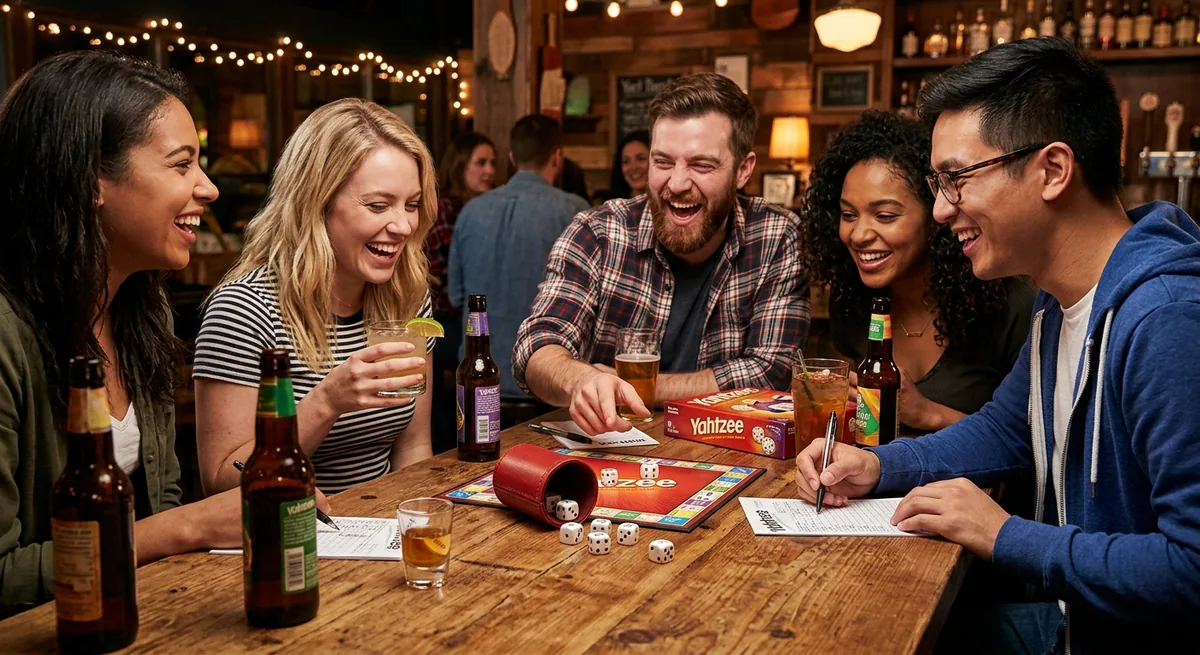
Turn classic Yahtzee into a drinking game with easy rules for failed rolls, busted turns, and group-size variations that keep everyone in the game.
Yahtzee already puts your luck on trial. Add drinks to the mix and every roll becomes a high-stakes moment. The sting of a failed three-of-a-kind, the Yahtzee that slipped away on the last roll, all of it bites harder when sips are on the line. The rules are fast to learn: failed categories cost a drink, busted turns cost two, and rolling Yahtzee gives you the power to assign drinks to anyone at the table. This game scales from two players on a slow night to a full party of ten without the core rules ever changing.
You only need five dice, your drinks of choice, and one scoresheet per player. Grab printable Yahtzee scoresheets before anyone pours a glass, so every player can track both rolls and drink totals without losing count mid-game. One sheet per person kills the "wait, did I already mark that?" argument before it starts.
Game Night Essentials
- Failed categories cost one drink; burning all three rolls with nothing usable costs two
- Near-misses like rolling four-of-a-kind while chasing Yahtzee carry their own penalty sip
- One scoresheet per player keeps drink tracking accurate and argument-free
- Group size changes how turns rotate, not the core drink penalty rules
- Agree on a house drink cap before anyone rolls the first die
The Core Drinking Rules That Drive Every Turn
The scoring structure stays standard. Each player takes up to three rolls per turn to lock in one category on their scoresheet. You hold any dice you want between rolls, exactly as in regular Yahtzee. The drinking penalties sit on top of the scoring, not in place of it.
Here is how the drink assignments break down for each outcome:
- Zeroed category: You fill in a zero because you could not hit the required combination. Take one drink.
- Busted turn: You burn all three rolls and still cannot mark anything useful on your sheet. Take two drinks.
- Crossed-out Yahtzee box: If you mark a zero in your Yahtzee slot without ever rolling five-of-a-kind, take three drinks at game end.
- Lowest score in a round: The player with the fewest points after everyone takes their turn sips once. This keeps late-game scoring competitive and prevents coasting.
- Successful Yahtzee: Roll all five dice matching and assign two drinks total to anyone at the table. This is the biggest power move in the game.
These five rules cover almost every situation the dice can produce. Once everyone knows the penalty framework, turns move fast. Each one runs under two minutes, which keeps the drink total building at a steady pace without overwhelming anyone early in the game.
Near-Miss Penalties That Punish Bad Luck
Near-miss rules are where this version of Yahtzee gets its teeth. Standard Yahtzee has no punishment for coming close. This version does, and that difference changes everything about how the game feels at the table.
A near-miss is any roll on your third and final attempt that leaves you one die short of a target category. If you were chasing a Large Straight and ended up with four of the five numbers you needed, that counts. Take one drink before marking your sheet.
The most brutal near-miss is landing four-of-a-kind while chasing Yahtzee. Four matching dice sit there with one stubborn misfit staring back at you. That is one drink for the near-miss. If you also decide to zero out your Yahtzee box rather than salvage a different category, add one more drink on top of it.
A useful house rule: only trigger near-miss penalties on the third and final roll. If you almost hit a category on roll one but shifted strategy, that does not count. This prevents the game from turning into a nonstop penalty parade before anyone has filled in half their scoresheet.
Groups that play without near-miss rules often say the game feels too forgiving. The near-miss layer gives bad luck stretches a real consequence, which in turn makes lucky streaks feel genuinely earned rather than ordinary.
Adjusting the Game for Different Group Sizes
The core drink rules never change based on headcount. What adapts is the format: how many rounds you play, how turns rotate, and whether you add bonus rules to account for table size.
Small Groups of Two to Four Players
With a smaller group, play a full 13-round game with all standard categories. Turns rotate back faster, so drink penalties land more frequently per person. To balance this, give the game winner the right to assign three drinks total at the end, distributed however they want among the other players.
Two-player games benefit from a head-to-head bonus rule. If one player outscores the other in a given round by more than 20 points, the lower scorer takes an extra drink. This sharpens the rivalry and prevents one player from cruising to an easy win with no real consequence.
Medium Groups of Five to Eight Players
At this size, a 13-round game can drag on too long. Cut it to eight rounds instead. Everyone fills in eight categories of their choice and leaves the rest blank. Any blank category at game end costs one drink each. This creates real strategy: do you protect your Yahtzee slot and risk blanking it, or fill it early with a zero and take the hit now?
For groups of six or more, add a hot seat rule. Every three turns, the player currently in last place takes one drink before their next roll. This keeps stragglers engaged and stops anyone from mentally checking out of a game they are losing by a wide margin.
Large Parties of Nine or More
Big groups work best in team format. Split into pairs or trios. Each team shares one scoresheet and takes alternating rolls. Drink penalties apply to the active roller, not the full team. A successful Yahtzee lets the rolling team assign three drinks split across any opposing teams however they choose.
Team Yahtzee also runs well as a bracket tournament. Set up multiple simultaneous games and have winning pairs advance. Losing teams take two drinks before the next bracket round begins. This format keeps large parties moving and gives everyone something to watch even when they are not rolling.
Variations That Change the Entire Flavor
Once your group has the base rules down, these variations keep things from going stale across repeat sessions:
- Reverse Yahtzee: The highest scorer at game end takes the most drinks instead of the lowest. Strategy flips entirely. Everyone plays defensively to avoid scoring too high, which turns normal Yahtzee decision-making completely on its head.
- Speed Rounds: Set a 30-second timer per turn. Fail to mark your sheet before time runs out and you take one drink and forfeit the turn. Adds pressure to a game that is already plenty unpredictable on its own.
- Category Bounties: Before starting, assign drink bounties to specific categories. Whoever fills in Full House first deals two drinks. Whoever hits Yahtzee forces everyone else to sip once. Bounties make category competition feel personal and strategic from roll one.
- Wildcard Die: Designate one die as the wildcard. If it lands on six during any roll, the active player drinks once before their next roll regardless of overall outcome. Pure chaos that has nothing to do with skill or strategy.
- Partner Penalties: Pair players up at the start. When one partner earns a drink penalty, the other must drink as well. This creates mutual accountability and turns individual scoring into a team effort even in a solo-format game.
Mix and match based on your group's energy level. Speed Rounds paired with Wildcard Die creates an intense version that moves fast and punishes hesitation. Category Bounties with Partner Penalties adds a layer of tension that makes every single roll feel personal.
Keeping the Night Going Without Going Overboard
A full Yahtzee game spans 13 rounds. With five or six players, that is a lot of turns, and drink penalties stack quickly during a bad luck streak. It is easy to underestimate how much you have consumed when the game has your full attention.
Set a house drink cap before the first roll. A common rule is a maximum of five drinks per person per game. Any penalties beyond that cap go into a "drink bank" that the final game winner collects at the end. This keeps the game enjoyable for players running cold on dice luck and prevents one person from taking a brutal hit during an unlucky session.
Familiarizing yourself with safe drinking practices before a long game night helps everyone set appropriate personal limits from the start, especially if your group mixes people with different tolerances or experience levels.
Keep water on the table throughout the game. One pitcher or a water bottle per player works well. Nobody should feel awkward pouring a glass mid-round. Groups that normalize hydration during game nights play longer and feel much better the next morning.
Eat before you play. If someone arrives on an empty stomach, pause for snacks before starting. This is a hard rule in longer sessions where drink totals climb across a full game and energy levels fluctuate toward the end.
From Your First Roll to Your Last Sip
Yahtzee as a drinking game works because the existing scoring structure already creates natural peaks and valleys of luck. Every failed roll, every busted turn, and every near-miss already stings. The drink penalties deepen that sting and make the highs feel genuinely earned rather than routine.
The variations give you room to grow the game across multiple sessions with the same group. Start clean with just the core rules for a first run. Add near-miss penalties once the base framework feels automatic. Layer in a variation on your third or fourth session and the game feels completely new again without needing to buy anything or relearn the rules from scratch.
Deal out the scoresheets, pick your house rules, and let the dice sort out who drinks. Every session lands differently. That is exactly what keeps people coming back to the table.
Contributed article. External links in contributed posts are marked sponsored. Our editorial policy.