Ten cups, two balls, eternal glory - the classic table sport.
Also known as: Beirut
Be the first to rate this game
Your rating:
Players 2-4 (2 teams)
You needTable, 20+ cups, 2+ ping pong balls
DrinkBeer
Intensity
Time15-30 min per game
Beer pong is the undisputed heavyweight champion of drinking games: two teams, ten cups a side, two ping pong balls, and a table that instantly becomes a stadium. The goal is beautifully simple - Arc a ball into your opponents' cups until none remain - But the culture around it is anything but. Trash talk, celebrity re-racks, redemption arcs and last-cup heartbreak have made beer pong the centerpiece of parties for decades.
This is the definitive rules reference: the standard setup, the throw-by-throw flow of a game, and every famous house rule - Re-racks, bounces, fingering, blowing, island calls, elbows and rebuttal - Explained clearly so your table never dissolves into a rules argument again. Agree on your house rules before the first throw, shake hands (or don't), and let the eye-of-the-tiger montage begin. Ten cups stand between you and glory.
What you need & setup
Set up on a long, sturdy table - Official tables are 8 feet, but any kitchen or folding table around 6-8 feet works.
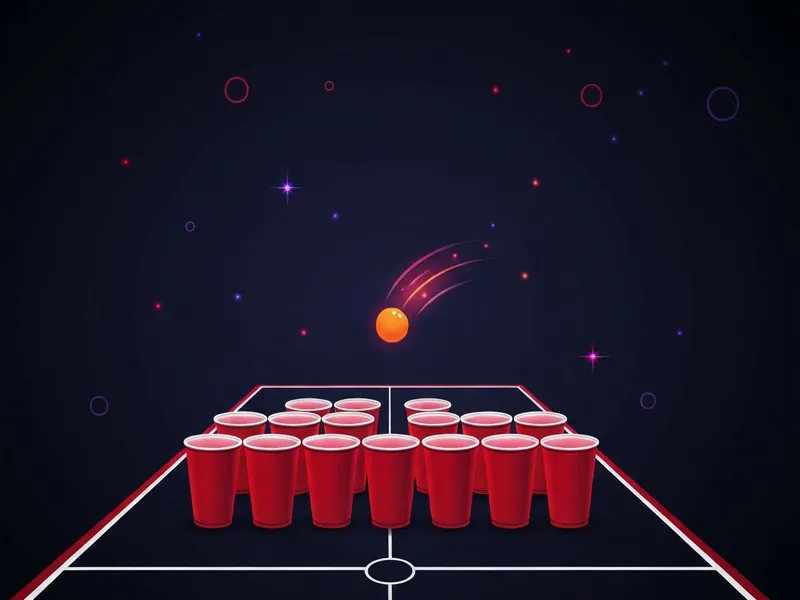
Arrange 10 cups per side in a tight 4-3-2-1 pyramid (point facing the opposition), rims touching, centered on the table edge.
Fill game cups with a small, equal amount of liquid - Many tables now use water in the cups and keep real drinks on the side.
Fill two extra cups with clean water for rinsing the balls between throws.
Form two teams of two (1v1 works too) and decide who shoots first - The classic method is 'eyes': one player per team shoots while maintaining eye contact, first make wins the ball.
Each team throws two balls per turn, one per player, from behind the edge of the table. You can shoot straight (an arc into a cup) or bounce the ball off the table into a cup. Standard rule: both teammates shoot each turn regardless of makes, and then the balls pass to the other side.
Remove made cups
When a ball lands and stays in a cup, that cup is dead. The defending team pulls it from the rack, drinks from it (or takes an equivalent sip of their own drink if the cups hold water), and sets it aside. The ball gets a quick rinse in the water cup before returning to play.
Earn balls back
If both teammates sink a cup on the same turn, they get the balls back and shoot again. Some tables also honor 'same cup' - Both balls in one cup counts as two or three cups and returns the balls. Confirm which version your table plays before the game starts.
Call your re-racks
Each team gets a limited number of re-racks (usually two per game) to reorganize their remaining cups into a tighter shape - Triangle, diamond, line, or the two-cup 'gentleman's rack'. Re-racks must be requested at the start of your own turn, never mid-turn while a ball is in the air.
Defend within the rules
Defenders can swat or catch a bounce shot at any time, but a straight arc must be left alone until it hits a cup. No reaching over the plane of the table, no blowing on the rim, no moving cups mid-flight - Interference on a legal shot typically costs the defenders a cup.
Close out the game
Sink the final cup and the game is yours - Pending redemption. The losing team gets a rebuttal: each player shoots until they miss, and if they clear every remaining cup, the game goes to overtime with a 3-cup rack per side. Win outright and the losers traditionally drink whatever remains on the winning side.
The rules
Ten cups per side in a 4-3-2-1 pyramid; two throws per team per turn, one per player.
Elbows: your elbow (or wrist, on strict tables) must stay behind the edge of the table when you release the ball - Leaning over is a void throw.
Bounce shots count double (two cups: the one it lands in, plus one of the defenders' choice) - But a bounced ball can be swatted or caught by the defense at any time.
Fingering: if the ball is spinning inside a cup, defenders may pull it out with a finger before it touches the liquid - House-dependent, agree in advance.
Blowing: the classic counterpart rule - Defenders may blow a spinning ball out of the cup. Many strict tables ban both fingering and blowing entirely.
Re-racks: two per team per game, requested at the start of your own turn. Common racks: 6-cup triangle, 4-cup diamond, 3-cup line, 2-cup vertical, and 1-cup center.
Island: once per game, a player may call 'island' on an isolated cup (one not touching any other). Make the called cup and it counts as two; hit a different cup and it doesn't count at all.
Both teammates sink cups in the same turn: balls come back and your team shoots again.
Same cup: both balls in a single cup in one turn counts as three cups (or two, house-dependent) and returns the balls.
Redemption / rebuttal: after the last cup falls, the losing team shoots until a miss. Clear the table and the game goes to 3-cup overtime; miss and it's over.
Interference: knock over your own cup and it's gone; defenders touching a straight shot before it hits a cup forfeit a cup.
On fire: make three cups in a row on consecutive turns (call 'heating up' after two) and you shoot until you miss.
Variations & house rules
Beirut (no paddles, straight throws)
In much of the US, 'Beirut' is simply the standard throwing game described above, distinguished from old-school paddle beer pong. If your crowd insists beer pong means paddles, this is the name for the version everyone actually plays: hand-thrown arcs, ten-cup pyramids, house rules attached.
Civil War (3v3 speed pong)
Three players per side, three balls in play at once, and no turns whatsoever - Everyone fires at will the moment they have a ball. Each player defends their own small rack, and when your cups are gone, you're out. It's beer pong at triple speed and quadruple volume. We have a full Civil War page.
Six-cup pong
The faster, tournament-friendly format: six cups in a 3-2-1 triangle per side, one re-rack, games in under ten minutes. Ideal for brackets, Beer Olympics events and crowded parties where a queue is forming, because nobody waits forty minutes for a table.
Death cup
A savage add-on rule: any pulled cup left un-drunk on the table is live. If an opponent lands a ball in it, the game is instantly over - No redemption. It enforces table hygiene through pure fear, and it produces the most dramatic endings in beer pong.
Grenades
A big-party variant where a made cup makes the defending team's entire turn worse: the cup's neighbors also get pulled if the shooter banks it in off a bounce, or the team must finish drinks on certain trick shots. Rules vary wildly by campus - Write yours down before you start.
Pro tips
Aim with a consistent arc, not a laser - A soft, high shot lands and stays in cups far more often than a flat fastball.
Pick a target cup before you shoot instead of aiming at the rack in general; back-row corner cups are statistically the safest early targets.
Save one re-rack for the endgame - A 2-cup or 1-cup rack late in the game is worth more than a pretty diamond at six cups.
Throw the bounce shot when defenders are distracted mid-celebration; it's a free extra cup against a team that isn't watching the table.
Rinse the balls every single throw and swap the rinse water often - Your future self will thank you.
Stay loose between turns. Tight shoulders miss; the best pong players treat the last cup exactly like the first.
Where Beer Pong fits on the shelf
Beer Pong lands mid-table for intensity (5th of 14 cups games), rated 3 out of 5.
It is one of the few games here that genuinely works with just 2 players, and it stays fun up to 4.
A typical session runs 15-30 min per game - a solid middle act for the evening.
Browse the full pong & cup games shelf to compare all 14 games side by side.
Beer pong's origins are most commonly traced to Dartmouth College fraternities in the 1950s or 1960s, where students reportedly began lobbing ping pong balls at cups on actual table tennis tables - Originally with paddles. The paddle-free throwing version, often called Beirut, is generally said to have emerged in the Northeast US in the 1980s, though exact credit is disputed. By the 2000s, national tournaments like the World Series of Beer Pong had turned it into a genuine table sport.
Drink responsibly: Play the water-cup version: water in the game cups, your own drink on the side, and a sip per made cup. It keeps the game sanitary and lets everyone control their pace. Eat beforehand, hydrate between games, and rotate out anyone who's had enough; the table will still be there. See our safety guide for pacing tips and alcohol-free versions.
Beer Pong FAQ
How many cups do you use in beer pong?
The standard game uses ten cups per side arranged in a 4-3-2-1 pyramid, plus one or two water cups for rinsing balls. Faster formats use six cups in a 3-2-1 triangle. You'll want 16-18 oz plastic party cups and at least two ping pong balls - More, realistically, because balls vanish under couches at a documented rate of one per game.
What is the elbow rule in beer pong?
Your elbow must stay behind the plane of the table's edge when you release the ball. Leaning over the table shortens the shot and is the single most contested foul in the game, so strict tables extend the rule to the wrist. Standard penalty: the throw doesn't count, and repeat offenders lose the throw entirely. Call it early, call it loudly, and agree on it before game one.
What is redemption or rebuttal in beer pong?
When a team sinks the final cup, the losing team gets one last chance. In the common version, each losing player shoots until they miss; if they clear every cup remaining on the table, the game goes to overtime - A fresh 3-cup rack per side, usually with no re-racks. If the shooters miss before clearing, the game ends immediately. Redemption is why no beer pong lead is ever safe.
Do bounce shots really count as two cups?
Under classic house rules, yes: a ball bounced off the table into a cup removes that cup plus a second of the defense's choosing. The trade-off is that a bounced ball is live - Defenders can swat or catch it the moment it touches the table, which they cannot do to a clean arc. That risk-reward balance is the whole point, so tables that play bounces as one cup usually ban swatting too.
Can you play beer pong without beer?
Absolutely, and most experienced hosts do. Fill the game cups with plain water and keep everyone's actual drink - Beer, seltzer, soda, anything - Beside them; when a cup is made, take an equivalent sip from your own. Same game, same stakes, none of the floor-flavored backwash, and players who aren't drinking alcohol can compete on exactly equal footing.