Cups
Quarters
Bounce a quarter into the glass - miss and pass, land and rule.
Drink, set, flip - the fastest team relay in party sports.
Also known as: Flippy Cup · Taps
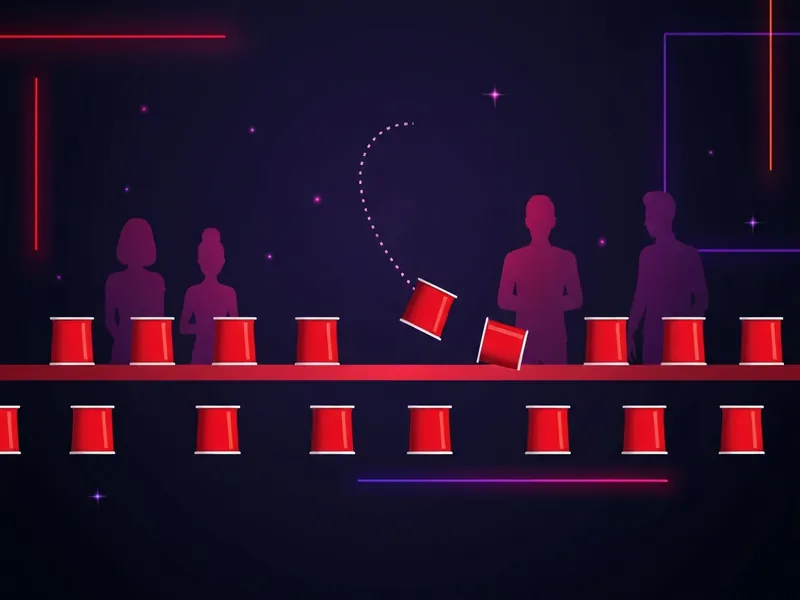
Flip cup is the great equalizer of party games. No aim required, no strategy meetings, no expensive gear - Just two lines of players facing off across a table, each with one cup, in a relay that lasts ninety glorious seconds. Drink your cup, set it on the table's edge, and flip it upside down with one flick of your fingers. The moment it lands, your teammate launches. First team to flip all the way down the line wins.
What makes flip cup legendary is the energy. It's the loudest game per square foot at any party: whole teams screaming at a single wobbling cup, instant rematches, best-of-seven grudge series that outlive the party itself. It works with four players or twenty, takes thirty seconds to teach, and turns strangers into teammates faster than any icebreaker ever invented. Line up, hands behind your backs, and wait for the count of three.
On 'go' (or after the cheers-tap-drink ritual), the first player on each team drinks the contents of their cup as fast as they can manage. Nobody else on the team may touch their own cup yet - Hands stay off until it's officially your turn. The lead-off leg sets the tone for the whole race.
Once empty, place your cup open side up so it hangs slightly over the table's edge - Roughly a quarter of the base off the table. This overhang is your launch pad. Rushing this placement is the number one rookie error: a sloppy set means a wild flip, and wild flips lose races.
With one or two fingertips under the overhanging rim, flick the cup upward so it flips 180 degrees and lands standing upside down on the table. Only your fingertips may touch it during the flip - No guiding it down, no two-handed cheating, no slamming it into place. If it lands crooked or rolls, reset it and try again.
The instant your cup lands flipped, the next teammate in line may start drinking. Not a moment before - Jumping the flip is a false start, and standard punishment is that the early player resets their full cup or the team repeats the leg. Watch your neighbor's cup, not the other team.
The last player in each line is the anchor, and anchors win championships. The race ends when the final cup on one side lands flipped. Close finishes are contested constantly, so appoint a neutral judge at the end of the table before the race if any pride, prizes or Beer Olympics points are on the line.
No flip cup game is played once. Losers demand a rematch, teams swap their weakest flipper to a new spot in the order, and a best-of-five becomes a best-of-nine. Shuffle the teams every few races so the same anchor doesn't carry all night, and keep refills small - This game runs many rounds.
After each race, the losing team votes one player off (or the slowest flipper walks). The shrinking team keeps racing the full-size squad, with remaining players drinking and flipping multiple cups to cover the gap. Last squad able to complete a race wins. Brutal, hilarious, and a great tournament finale.
Instead of ending at the anchor, the race turns around: once the last player flips, it comes back up the line in reverse, and every player drinks and flips a second cup. Doubles the race length and gives early-leg players a redemption arc when the return trip gets sloppy.
The summer supersize: players sprint and dive down a slip-and-slide before popping up to drink and flip at the table. One of the greatest backyard spectacles in drinking-game history and a full page on this site - See Slip 'N Flip for setup and rules.
Set a 3x3 grid of nine cups at the table's center. Two players race to drink and flip at their own station; each successful flip lets them claim a grid square with their marker cup. Three in a row wins. A clever head-to-head format when you don't have numbers for full lines.
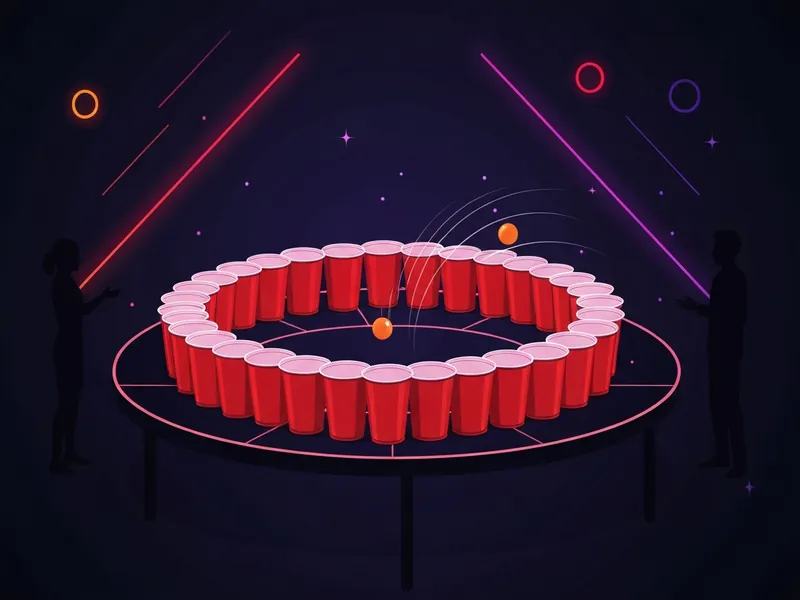
Teams stand in a circle rather than lines, and the flip travels around it - Sometimes with the whole circle racing a timer instead of an opposing team. Great for parties where one big group beats two separated ones, and a good format for setting 'house record' lap times.
Flip cup's exact origins are murky, as is tradition for games invented at parties. It's widely believed to have spread through US college campuses in the 1980s and 1990s, sometimes under the names 'flippy cup' or 'taps,' with East Coast schools often credited. Whatever the true birthplace, it traveled fast precisely because it needs nothing: cups, a table, and two teams. By the 2000s it was a fixture of tailgates and a core Beer Olympics event.
Published · Last updated · How we research games
Bounce a quarter into the glass - miss and pass, land and rule.
Bounce, stack, chase - the loudest circle in cup games.
Sink it fast or get your cup slapped across the room.

One center cup, everyone's fate hanging over it.

Sprint, slide, then stick the flip - summer's greatest relay.
Teams, events, medals - the full games, with beer.
BestDrinkingGame.net is a drinking-games site made for adults. Please confirm you are of legal drinking age before you come in.
By entering you agree to our terms and to drink responsibly. Know the legal drinking age where you live (21+ in the US).
You need to be of legal drinking age to use this site. Thanks for stopping by, and stay safe.
Every game here can also be played alcohol-free once you're old enough. See you soon.