
Dice
Drunk Farkle
Push your luck one roll too far and drink the difference.
A table, four cups and a die flying at terminal velocity.
Also known as: Snappa
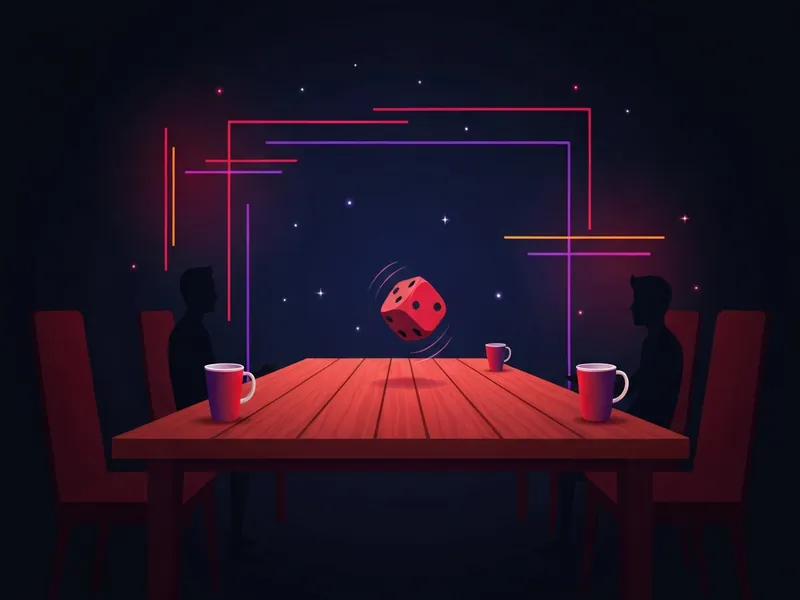
Beer Die - Snappa, to some houses - is the athletic aristocrat of dice drinking games. Two teams of two sit at opposite ends of a long table, each guarding a pair of cups, and take turns lobbing a single die high into the air at the far half. Land the die on the table so it drops off the edge uncaught, and you score. Plunk it into a cup, and things get loud.
Unlike every other game in the dice category, Beer Die is a genuine sport: there are serves, one-handed catches, defensive dives and heated line calls. Games run to a set score with a win-by-two finish, and good tables develop house doctrine about ceiling height and toss arc. If beer pong is basketball, Beer Die is tennis played by people holding drinks.
The die must be lobbed underhand or with a gentle flick, and it must reach a minimum height - house standard is above the thrower's head, stricter tables demand it clear an agreed ceiling line. Low, flat throws are illegal and score nothing. The arc is the sport: a good toss hangs long enough to be defended and drops steeply.
You score one point when your die lands on the opponents' half of the table and falls off any edge without being caught. The defense may catch it one-handed only, after it leaves the table and before it touches anything else - trapping it against a body or the floor does not count. A clean catch kills the point dead.
Hitting an opponent's cup with the die is a plink: worth a point at most tables, and the defending team drinks. Sinking the die INTO a cup is the crown jewel - typically two points, and the cup's owner must fish the die out and drink the cup. Some houses rule a sunk die wins the game outright. Agree beforehand, in writing if necessary.
Defense is where legends are made. Any die coming off your half may be caught one-handed for a clean kill; drop it or use two hands and the point stands. You may not interfere with a die while it is still on the table or could still hit a cup - goaltending gives the throwers the point plus a drink.
Beer Die drinking runs on penalties and intervals: drink when your cup is hit or sunk, when you drop a catchable die, and when your team is scored on. Tradition adds a communal sip whenever anyone says the number five - the forbidden number, called 'bizz' instead - which sounds absurd and becomes second nature disturbingly fast.
Teams alternate throws, with teammates alternating tosses. Play to your target score, win by two, and honor the sacred etiquette: shooters call their own height violations, defenders call their own drops, and disputed points are replayed without whining. Winners hold the table; challengers bring the next round.
The stricter cousin: points only count on dies that hit the table and drop off the back edge, height calls are hawkishly enforced, and every point requires the throwing team to confirm 'good height' from the defense. Slower, more formal, and beloved by veterans who consider standard Beer Die anarchic.
Add the underclassman rule set: dropped catches cost a full extra sip, sunk cups end the game instantly regardless of score, and the losing team drinks whatever remains in all four cups. Fast, brutal and best reserved for tables that know their pace - this is Beer Die at maximum wattage.
Extend the forbidden-number rule: 'five' is bizz and 'seven' is buzz, and violations cost a sip each. Since scores in a win-by-two game hover around those numbers constantly, the table's vocabulary collapses into gibberish by game three. A beautiful marriage with the word-game category.
Full sport mode: water in the corner cups, points only, no drinking rules at all. Beer Die is genuinely fun as a pure skill game, and Dry Die is how leagues run brackets and how you practice your arc without commitment. The diving catches remain exactly as heroic.
Six players, three cups per end, throwers rotating in fixed order. The extra cup crowds the corners and roughly doubles plink frequency, so cut the cup-drink penalties in half. Not traditional, but the correct answer when six people and one table all want in.
Beer Die's origins are contested territory - several New England colleges claim it, with accounts commonly pointing to campuses in Maine and Vermont sometime in the 1970s, and the name Snappa attached to a related tradition. No definitive record settles it, and honestly no bar argument ever will. What is certain is that it spread through college leagues, spawned governing-body-style rule sets, and inspires more house-rule fundamentalism than any game here.
Published · Last updated · How we research games
Push your luck one roll too far and drink the difference.
Roll a three, crown a victim - long live the Three Man.
Roll a 7, 11 or doubles and watch someone scramble to chug.

Find your 6, your 5, your 4 - then sail on the leftovers.
Ten cups, two balls, eternal glory - the classic table sport.

Knock the bottle off the pole - catch the frisbee or drink.
BestDrinkingGame.net is a drinking-games site made for adults. Please confirm you are of legal drinking age before you come in.
By entering you agree to our terms and to drink responsibly. Know the legal drinking age where you live (21+ in the US).
You need to be of legal drinking age to use this site. Thanks for stopping by, and stay safe.
Every game here can also be played alcohol-free once you're old enough. See you soon.