Cups
Slap Cup
Sink it fast or get your cup slapped across the room.
Bounce, stack, chase - the loudest circle in cup games.
Also known as: Stack Cup · Boom Cup
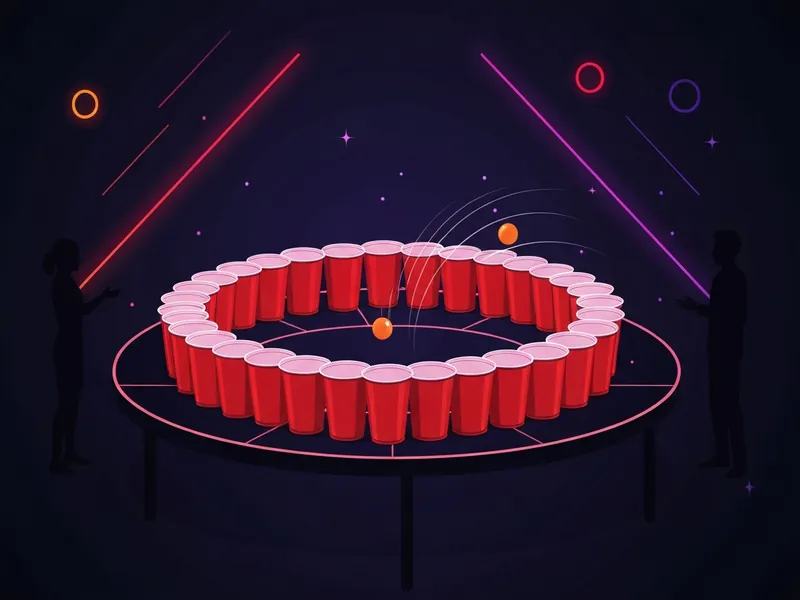
Rage Cage - Also answering to Stack Cup and Boom Cup - Is what happens when beer pong sheds its manners. Thirty-plus cups form a ring around one big center cup, two balls circle the table at panic speed, and every player is either bouncing frantically or screaming at someone who is. Sink your ball in an empty cup, stack it, and pass the pressure left. Get caught, and you're drinking whatever fate put in front of you.
It's the best big-group cup game ever devised because nobody waits: there are no teams to pick, no turns to track, and no skill floor that leaves beginners on the bench. The chase mechanic - Two stacks hunting each other around a circle - Creates a wave of noise that pulls the entire party to one table within minutes. All roads lead to the center cup, and someone at this table is destined to drink it.
The two starting players, standing directly across from each other, begin at the same moment: each tries to bounce their ping pong ball off the table and into their own empty cup. This is the game's only shot - One bounce, into the cup you're holding responsibility for. On 'go,' the table erupts and does not quiet down again.
The instant you sink your bounce, pass the cup (ball inside) to the player on your left, who fishes out the ball and starts bouncing immediately. There is zero downtime in rage cage: the two cups travel counterclockwise around the circle at whatever speed the table's collective panic can sustain.
A first-attempt make is special: instead of passing left, you may hand your cup to any player at the table. This is the game's targeting weapon - Dump pressure on the friend who just got caught, or on the table's smuggest sniper. Expect retaliation for the rest of the evening.
If the cup behind catches the cup ahead - You sink your ball while your neighbor is still bouncing - You slam your cup inside theirs. They've been caught: they take the new stack, grab a fresh cup from the middle ring, drink its contents, and start bouncing into the empty. Meanwhile the growing stack gets passed on and the chase resumes.
Every catch adds a cup to the stack, so both traveling stacks get taller and easier to hit as the game accelerates. The middle ring shrinks cup by cup as caught players drink through it. The rhythm gets faster, the bounces get sloppier, and the noise gets genuinely unreasonable. This is the rage cage working as intended.
When the final ring cup is drunk, only the center cup remains. The next player who gets caught - Stack slammed on their bounce - Drinks the Rage Cage itself, and the game ends in cheers and one person's quiet regret. House alternative: the last catch triggers a head-to-head bounce-off, loser drinks the center.
The sibling game with violence built in: instead of stacking a caught player's cup, you slap it clean off the table, and they must retrieve it before drawing from the middle and resuming. Same circle, same bouncing, more cardio and flying cups. It's popular enough to have earned its own full page on this site.
Each catch, the catcher yells 'BOOM' and the whole table must slam a palm on the table; the last hand down drinks a bonus sip from their own drink. Adds a reflex mini-game for everyone not currently holding a ball, and roughly doubles the volume of an already loud game.
The center cup is a mixed 'suicide cup' built by the table before the game - A splash from every player's drink of choice. Nobody wants it, which makes every late-game bounce genuinely terrifying. Keep contributions sensible: gross is funny, dangerous is not. No hot sauce economies of scale.
For crowds of twelve or more, run three or four cups and balls simultaneously instead of two. Catches can happen anywhere in the circle at once, and the stacks weave past each other in traffic. Recommended only for veteran tables; it's the difference between a rainstorm and a hurricane.
Pre-set the ring at exactly one cup per player plus the center. Every player is guaranteed to drink at most a couple of cups, the game has a fixed length, and hosts can control the total pour precisely. The recommended format for longer parties, tournaments and school-night gatherings.
Rage Cage's origin story is appropriately chaotic: nobody can credibly claim it. The game appears to have grown out of the same US college cup-game culture that produced beer pong and slap cup, spreading through campuses in the 2000s under a pile of regional names - Stack Cup, Boom Cup, Chaos Cup and others. Its family resemblance to speed quarters, with cups chasing each other around a circle, suggests it evolved from that older coin game once ping pong balls took over party tables.
Published · Last updated · How we research games
Sink it fast or get your cup slapped across the room.

One center cup, everyone's fate hanging over it.
Beer pong with no turns - three racks, endless fire.
Four cups, four bases - swing for the back cup homer.
Roll a 7, 11 or doubles and watch someone scramble to chug.
The king of card drinking games - every card is a rule.
BestDrinkingGame.net is a drinking-games site made for adults. Please confirm you are of legal drinking age before you come in.
By entering you agree to our terms and to drink responsibly. Know the legal drinking age where you live (21+ in the US).
You need to be of legal drinking age to use this site. Thanks for stopping by, and stay safe.
Every game here can also be played alcohol-free once you're old enough. See you soon.