
Challenge
Das Boot
Pass the glass boot around - don't be the one who gets splashed.
Heels up, hands on the keg - the countdown is the crowd's job.
Also known as: Keg Stands
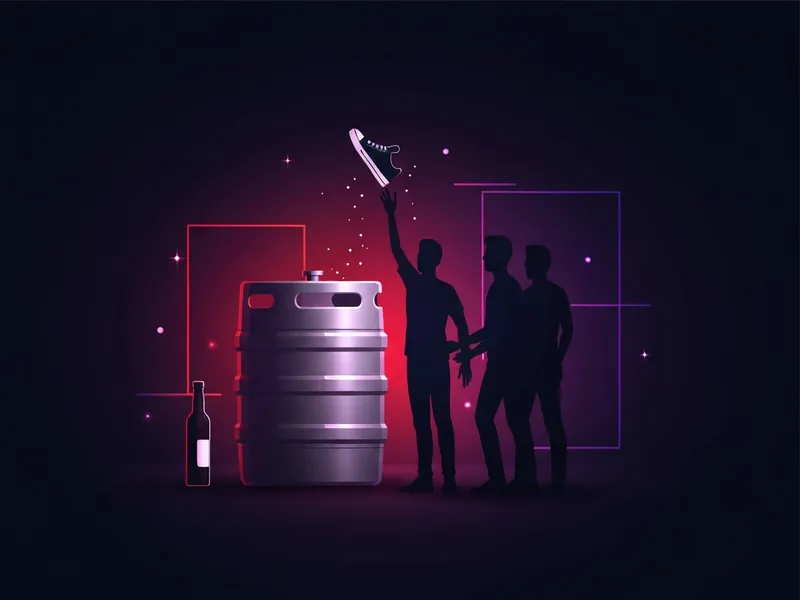
The keg stand is less a game than a rite: hands on the rim of the keg, two spotters hoisting your legs skyward, the tap in your mouth, and the whole party counting out loud for as long as you drink. That count is your score. It's the loudest thirty seconds at any party with a keg - Equal parts gymnastics, theater and peer-reviewed chugging - And it has been closing out backyard parties for generations.
It's also, hands down, the game on this site that most needs doing properly. Upside down, blood rushes to your head, swallowing gets harder, and you're relying entirely on two people holding your ankles. Done right - Short counts, strong sober spotters, a clear tap-out signal, zero pressure on anyone - It's a roaring photo op. Done wrong, it's a dropped guest and a bad night. This page is the doing-it-right manual.
The drinker grabs the keg's top rim with both hands, arms straight, shoulders stacked over wrists - Like the top of a push-up. A full half-barrel weighs over 150 pounds and won't tip, but your grip still carries your weight, so plant both hands before anything leaves the ground and keep them there for the entire stand. Rings off; the rim bites.
The spotters take one leg each at the ankle and calf and raise the drinker smoothly into an assisted handstand - A controlled lift, not a toss. The drinker's job is to stay rigid; the spotters' job is to keep the hips over the shoulders and never let go, not even for a phone. Nobody goes upside down without both spotters set and confirmed.
The tap operator places the nozzle in the drinker's mouth and opens the flow gently - A firehose start ends stands in one cough. Drinking upside down is genuinely awkward: swallow in small, steady pulls and breathe through your nose. The moment swallowing stops feeling controlled, you're done. There is no version of pushing through it that ends well.
The crowd counts out loud from the second the tap opens: 'one... two... three...' The count is the whole scoreboard - No cups, no measures, just seconds survived with style. Counts in the ten-to-fifteen range are respectable; anything past twenty is theater. Long counts are for the crowd's benefit, not the drinker's, and short is genuinely fine.
The instant the drinker signals - Double leg-tap, waving hand, or simply stopping swallowing - The tap closes and the spotters lower their legs slowly to the ground. No dropping, no dramatic release. The drinker should come up slowly and stand still for a few seconds; standing up fast after being inverted invites a head-rush wobble exactly when balance is worst.
One stand per person per stretch - Keg stands are a highlight, not a rotation you grind. Log the counts somewhere visible if you're playing it as a game, crown the night's champion, and let the keg go back to filling ordinary cups. Anyone is allowed to pass forever, and a good host makes 'no thanks' land exactly as smoothly as a twenty-count.
The classic competitive frame: everyone who wants in takes one stand across the night, counts get chalked on a board, and the longest count wins a trophy nobody respects. Enforce the house ceiling anyway - A 15-second cap keeps the contest about style and crowd noise instead of endurance, and ties are settled by loudest crowd reaction, not a second attempt.
Teams of three take one stand each, and the team's combined count is its score. Because every member's seconds matter equally, the incentive flips toward three tidy, controlled stands rather than one hero run - Structurally the safest way to make keg stands a game. Spotters must still be the standing sober crew, never the teammates awaiting their turn.
All the theater, none of the inversion: the 'stand' is simply drinking from the tap while the crowd counts - Feet on the ground, one hand on the keg, maximum showmanship encouraged. Perfect for guests who want the spotlight without going upside down, and a smart default once the night is past its midpoint. The crowd counts exactly as loudly. Nobody actually checks your feet.
The zero-alcohol version that still makes the album: full handstand form on the keg, spotters holding, crowd roaring - With the tap closed or a water line in hand. Ideal for the designated drivers and for round two of pictures once drinking stands are done for the night. Same spotter rules apply; gravity doesn't care what's in the hose.
The keg stand is an American party tradition tied to the golden age of the college keg party, and most accounts place its rise in the 1970s and 1980s fraternity scene - Though, as with any stunt invented beside a keg, no one can credibly claim the first one. The crowd-counting ritual seems to have been there from early on, spread by word of mouth and, later, by every college movie that needed a party montage.
Published · Last updated · How we research games
Pass the glass boot around - don't be the one who gets splashed.

Name your odds, count to three, and pray your numbers don't match.
Left hand red, right hand... whose leg is that? Fall and you drink.

A funnel, a tube, and gravity - the fastest beer you'll ever drink.
Ten cups, two balls, eternal glory - the classic table sport.
One shot of beer, every minute, for sixty minutes.
BestDrinkingGame.net is a drinking-games site made for adults. Please confirm you are of legal drinking age before you come in.
By entering you agree to our terms and to drink responsibly. Know the legal drinking age where you live (21+ in the US).
You need to be of legal drinking age to use this site. Thanks for stopping by, and stay safe.
Every game here can also be played alcohol-free once you're old enough. See you soon.