Drinking Games for 2 People
Most drinking game lists assume you have a full house party on tap. But some of the best nights are just two people, a table, and a little competitive tension - a roommate, a partner, an old friend crashing on your couch. The trick is picking games built for head-to-head play: fast turns, real stakes, and no mechanics that need a circle of eight to work. Here are the two-player games that actually hold up, plus how to set them up and pace them so the night lasts.
What makes a good 2-player drinking game
With two players there is nowhere to hide. Games that lean on group chaos - whispered questions, table-wide counting, pointing at the guilty - fall flat, because every mechanic lands on the same two people each round. What you want instead is direct competition: guessing duels, bluffing battles, and aim games where every turn is you versus them.
You also drink far more often with two people than with ten, because every penalty hits one of you. A game that feels tame with eight players can be surprisingly heavy head-to-head, so start slower than you think you need to.
| If you want… | Best pick | Why it works for two |
|---|---|---|
| Fast and easy to learn | Higher or Lower | 10-second rules, instant trash talk |
| A bluffing battle | Liar's Dice | Every call is aimed right at them |
| A dramatic finish | Ride the Bus | One of you drives; the other gloats |
| Real conversation | Truth or Dare | Answer or sip - bold questions feel safe |
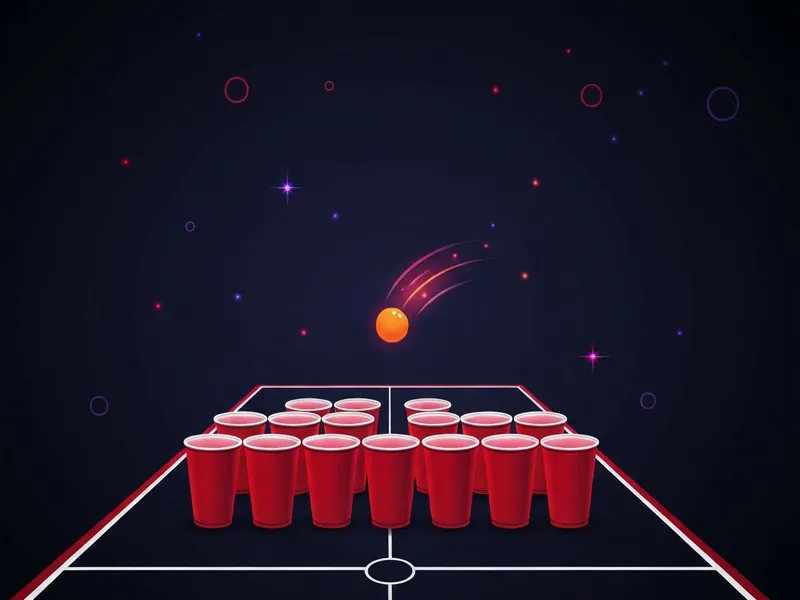
| A table sport | One-on-one beer pong | 6 cups a side keeps it tight and fast |
Card games built for duels
A single deck is the best two-player kit there is. Start with Higher or Lower, the simplest bet in cards: flip a card, call the next one higher or lower, and drink when you are wrong. It takes ten seconds to learn and creates instant trash talk. Deal five cards each and alternate calls to keep both of you locked in.
Two-player card games to learn first
When you want more texture, Ride the Bus works brilliantly with two. The guessing rounds are pure head-to-head, and whoever ends up driving the bus provides the evening's main event.
Drunk Uno is the low-key option - the familiar family game with drinking penalties on every draw-two and reverse. It is perfect for a night where conversation matters as much as the game.
Duel cards that get even better with a third player
Irish Poker is the best of these head-to-head. You each lay out four cards and make four calls - red or black, higher or lower, inside or outside, and the exact suit - drinking for every miss. That turns a round into a tense best-of-four.
Indian Poker is pure bluff: press one card to your forehead so your opponent sees it and you cannot, then bet on whose hidden rank is higher.
Two more wait in your back pocket. Screw Your Neighbor - shove your low card onto the player beside you - and Electricity - where a matched flip sends a current around the circle - both come alive the instant your duo becomes a trio.
Dice games: bluffing is better with two
Dice bluffing games were practically designed for duels. With no crowd to hide in, every claim is a direct challenge - and the reads get sharp fast.
Bluffing dice for two
Liar's Dice is the standout - five dice each, hidden under cups, and a rising ladder of claims until someone calls the bluff. With only two players every call is personal, and you learn your opponent's tells fast.
Mexicali scratches the same itch with just two dice: roll under a cup, announce your number, and dare them to doubt you.
Lighter luck-based dice
For something calmer, Ship, Captain & Crew is a pure luck race that plays great across a kitchen table. Drunk Farkle adds push-your-luck scoring, where getting greedy costs you sips.
Both give you natural pauses between rounds - handy for pacing a long two-person night.
Talking games that turn into real conversations
Prompt games are secretly at their best with two people, because the answers get honest. Never Have I Ever becomes a slow-burn story exchange rather than a party spectacle - every statement invites a follow-up. Truth or Dare played as truth-or-drink is the classic two-person format: ask anything, and they either answer or sip.
Questions is a fantastic sleeper pick - you may only speak in questions, and answering one costs a drink. With two players it becomes a fast, funny verbal fencing match. Playing with a partner rather than a friend? Our couples and date night guide has versions tuned for two people who like each other.
Aim and skill games, scaled down
You do not need teams for table sports. Beer Pong plays perfectly one-on-one - use six cups a side instead of ten for a tighter, faster game where every shot matters. Quarters needs nothing but a coin and a glass, and head-to-head it becomes a rhythm battle: land your bounce and keep shooting while your opponent stews.
Drunk Jenga is the best sit-down option. Write rules on the blocks once, and the set pays for itself for years. With two players the tower falls faster and the rules hit harder, so keep the written penalties on the lighter side.
- One-on-one beer pong - 6 cups a side, rerack at 3 and 1
- Quarters - first to five sunk shots wins the round
- Drunk Jenga - loser of each collapse finishes their drink
Pacing a two-person night
Two-player games concentrate every drink onto two livers, so build the night in phases. Open with a low-intensity talking game, move to cards or dice for the competitive middle hour, and save anything chug-based for a single showcase round rather than a repeating loop.
Small sips are the two-player golden rule. Define one drink as a modest sip before the first round, and use finish-your-drink penalties sparingly. Want the games without the alcohol load at all? Every game above converts cleanly to points or dares - see our sober-friendly versions guide for exact swaps.
Frequently asked questions
What is the best drinking game for exactly 2 people?
Can you play beer pong with only 2 players?
How do you keep a 2-person drinking game from getting too drunk too fast?
Do 2-player drinking games work over video call?
Published · Last updated · How we research games