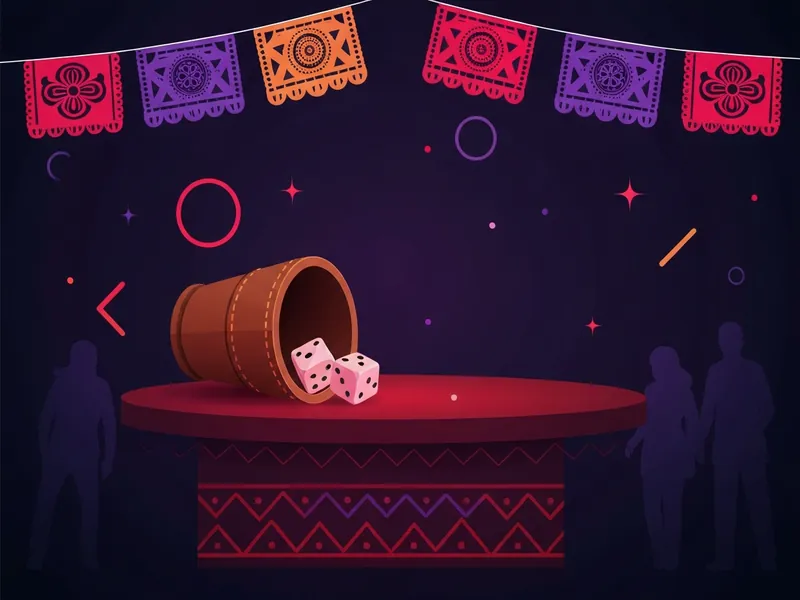
Dice
Mexicali
The 21 beats everything - if you believe the roller.
Five dice, one cup, zero honesty - call the bluff or drink it.
Also known as: Dudo · Perudo · Pirate's Dice

Liar's Dice is what happens when poker and dice have a beautiful, dishonest child. Every player shakes five dice under a cup, peeks at their own roll, and then the table starts bidding on how many of a given face exist across ALL the hidden dice combined. Each bid must climb higher than the last, so sooner or later someone is claiming something absurd - and someone else is shouting 'Liar!'
When the challenge comes, every cup lifts, the dice are counted, and somebody was wrong. The loser drinks and surrenders a die, shrinking their hand and their information for every round after. Last player holding dice wins. It works from an intimate two-player duel up to a six-person table of paranoia, and it rewards nerve, math and a completely straight face in equal measure.
Every round starts with all players shaking their dice under their cups and slamming them down. Lift the edge and memorize your own roll - that is your only certain information all round. Everything else at the table is inference, probability and the look on your friends' faces.
The first bidder names a quantity and a face: 'four 3s' means they claim at least four 3s exist under all the cups on the table combined, theirs included. Opening honest is normal; opening with a lie is art. Your own dice anchor the claim - holding three 3s yourself makes 'four 3s' nearly a sure thing.
Moving clockwise, each player must either raise the bid or call the bluff. A raise increases the quantity ('five 3s') or keeps the quantity and raises the face ('four 5s'). Bids only ever climb, which is the ratchet that forces a confrontation - the table cannot circle politely forever.
When you think the last bid cannot be true, call 'Liar!' All cups lift and the relevant face is counted across every die on the table. If the bid was good - the count meets or beats it - the challenger loses. If the count falls short, the bidder was lying and pays the price. Either way, somebody's drinking.
The round's loser takes a solid drink and removes one die from their cup permanently. This is the beautiful death spiral: fewer dice means less information and weaker bids, which means more drinking. A player who loses their final die is out of the game - though never out of drinking-along range.
The loser of each round opens the bidding for the next. Rounds accelerate as dice leave the table and bids get tighter. When only one player still holds dice, they are the champion, and the traditional spoils apply: they assign a final drink to any player of their choosing. Choose spitefully.
| Roll | What happens |
|---|---|
| Bid raised | Each bid must raise quantity or face value |
| 'Liar!' called correctly | Bluffer drinks and loses a die |
| 'Liar!' called wrongly | Challenger drinks and loses a die |
| Ones | Wild - count as any face (house rule) |
Besides 'Liar!', a player may call 'Spot on!' - claiming the last bid is exactly right. If the count matches precisely, everyone EXCEPT the caller drinks and the caller reclaims a lost die. If not, the caller drinks twice. A low-odds, high-drama lifeline straight from Perudo.
Play with 1s as ordinary faces rather than wilds. Counting gets stricter, bids get lower, and bluffs get easier to catch - the game becomes more poker, less lottery. Recommended once your table has a few nights of experience and someone has started actually doing the math.
When a player drops to their very last die, the next round is played in their honor: 1s are not wild and the face named in the opening bid cannot be changed by later raises, only the quantity. It briefly hands the dying player real power, which is the most piratical rule imaginable.
Two players in a tavern-style duel each roll five dice, and the drinking scales with the miss: whoever loses the challenge drinks the difference between the bid and the true count in sips. Turns wild overbids into genuinely expensive decisions and makes head-to-head play sing.
For any group size: the round's loser drinks one sip per die they were off by, rather than a flat penalty. Confident, close calls cost little; deranged bids of 'nine 6s' cost a small fortune. It elegantly punishes exactly the behavior it should.
Liar's Dice is often traced to South America, where the Spanish encountered a game the Incas' descendants knew as Dudo - 'I doubt' - and versions of the story credit conquistador-era sailors with carrying it across the Atlantic. Whatever the true route, it spread through ports worldwide, picked up the name Pirate's Dice along the way, and was commercialized as Perudo in the twentieth century. The drinking version is likely as old as the game itself.
Published · Last updated · How we research games
The 21 beats everything - if you believe the roller.

Six cups, one die - fill it, roll it, and pray for empties.
Two ones and the table drinks - simple, sudden, savage.
A table, four cups and a die flying at terminal velocity.

Outguess the dealer or put them out of their misery.

You heard your name - drink to find out what they asked.
BestDrinkingGame.net is a drinking-games site made for adults. Please confirm you are of legal drinking age before you come in.
By entering you agree to our terms and to drink responsibly. Know the legal drinking age where you live (21+ in the US).
You need to be of legal drinking age to use this site. Thanks for stopping by, and stay safe.
Every game here can also be played alcohol-free once you're old enough. See you soon.