Word
Two Truths and a Lie
Spot the lie or drink - the classic icebreaker with a twist.
Drum the table, throw your sign, catch theirs - miss and drink.
Also known as: What's the Name of the Game?
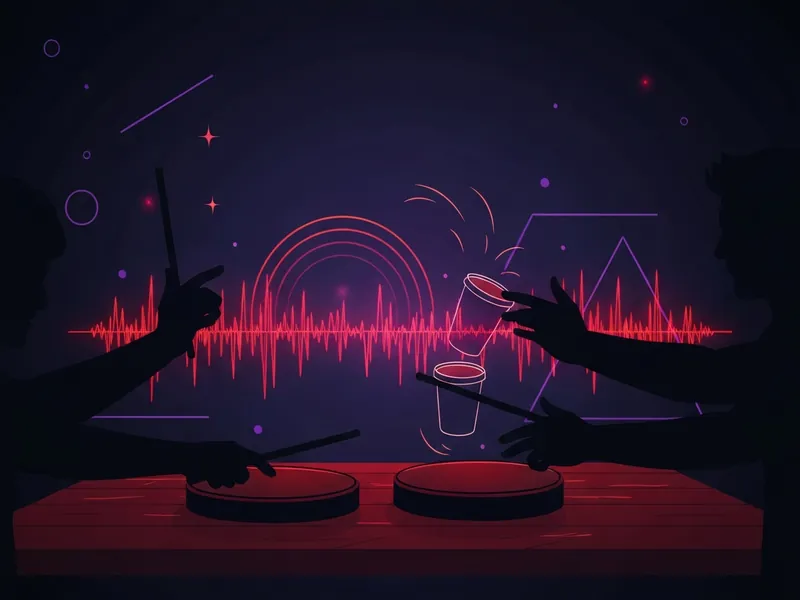
Thumper is the drinking game that sounds like a stampede. Everyone picks a personal hand sign - antlers, a salute, finger guns, a tiny violin - and shows it to the table. Then the drumming starts: everyone pounds a steady beat on the table. The starting player throws their own sign, then someone else's sign. That player must instantly answer with their own sign and pass to a new victim. Miss your cue, flash the wrong sign, or lose the beat entirely - you drink.
It's a reflex game wrapped in a rhythm game wrapped in a memory test, and the drumming makes everything harder: your brain has to recognize signs, recall who owns what, and fire back, all while your hands are busy pounding the table. Add the traditional call-and-response opening and Thumper feels less like a game and more like a ritual summoning - which, at volume three intensity, it basically is.
Each player invents a personal hand sign - moose antlers, a hair flip, a chef's kiss, a dramatic point. Signs must be distinct, visible, and performable in under a second. Everyone demonstrates theirs twice while the table watches, then the group does a review lap. You are responsible for knowing every sign at the table. Yes, all of them.
Everyone drums a steady beat on the table with both palms - not too fast, just relentless. The traditional opening: the leader shouts 'What's the name of the game?' and the table roars 'THUMPER!' Leader: 'And why do we play?' Table: 'TO GET DOWN!' The beat never stops. The game has now legally begun.
The starting player, while everyone keeps drumming, performs their own sign, then immediately performs another player's sign. That's the pass. The named player must respond the same way: their own sign first, then a new player's sign. Own sign, someone else's sign, always in that order - it's the grammar of the entire game.
When your sign gets thrown, the clock is already expired. Respond within a beat or two: your sign, then your target's sign, hands returning to the drum between moves. The drumming denies you thinking time - that's its job. Freezing, flashing your sign late, or staring blankly while the table watches you process are all fails.
A player drinks for: missing their cue, doing their own sign wrong (it happens, gloriously), throwing a sign nobody owns, passing back illegally if your table bans instant returns, or stopping the drumbeat. When someone fails, the beat stops, the penalty is paid, and the drummer who failed restarts the chant. The ritual must be respected.
Each restart, nudge the tempo up. Faster drumming means less recognition time, and the failure rate climbs beautifully. Endgame Thumper - six players, high speed, everyone's forearms aching, someone confidently performing a sign that belongs to no one - is one of the great spectacles in all of drinking games. Ride it until the table (or the neighbors) gives out.
After every fail, the failing player must trade signs with the person on their left. Everyone's carefully memorized sign map slowly rots as the game progresses, and the fails compound. By round ten, nobody is sure which antlers belong to whom. This is the variation for groups who found base Thumper too learnable.
The drumming continues, but all talking, laughing, and sound-effects are banned - signs only. Any vocalization is a drink. The forced silence under thunderous drumming creates an absurd tension, and watching someone try to silently protest a bad call with only their moose antlers is peak comedy. Bad calls stand, by the way. House rules.
On your turn, you throw your own sign and then TWO other players' signs; both must respond in the order thrown. Collisions, panic, and simultaneous antlers ensue. Only attempt with six or more players and a group that has already mastered standard passing, or the game collapses instantly - which is also entertaining, once.
Elimination mode: fail and you're out (after your sip), but - crucially - your sign remains in play. Throwing a dead player's sign is now itself a fail. The pool of legal signs shrinks while the memory burden stays, and the final two players duel at maximum tempo over a graveyard of forbidden gestures. Winner names the next game.
Split into two teams on opposite sides of the table, each drumming their own beat. Signs pass within teams, but each player may once per round 'raid' by throwing an opponent's sign, forcing a cross-table response. A team drinks together when any member fails. Louder than regular Thumper, which should be physically impossible.
Thumper is widely reported as a campfire and summer-camp game long before it reached the party circuit, often played under the call-and-response 'What's the name of the game?' opening that survives in the drinking version. Its sign-passing engine resembles other folk circle games from mid-20th-century North America, though documentation is thin. College students likely converted it to a drinking game decades ago, and it now lives wherever there's a table sturdy enough to survive it.
Published · Last updated · How we research games
Spot the lie or drink - the classic icebreaker with a twist.
Pick a topic, go around the circle, don't you dare blank.
One word, endless rhymes - until someone runs dry.
Say the first thing that comes to mind - hesitation costs a sip.
Bounce, stack, chase - the loudest circle in cup games.
Sink it fast or get your cup slapped across the room.
BestDrinkingGame.net is a drinking-games site made for adults. Please confirm you are of legal drinking age before you come in.
By entering you agree to our terms and to drink responsibly. Know the legal drinking age where you live (21+ in the US).
You need to be of legal drinking age to use this site. Thanks for stopping by, and stay safe.
Every game here can also be played alcohol-free once you're old enough. See you soon.