Word
Bizz Buzz
Count around the circle - but 5s bizz, 7s buzz, and brains melt.
Say it fast around the circle - one slip and you're drinking.
Also known as: Ducky Fuzz
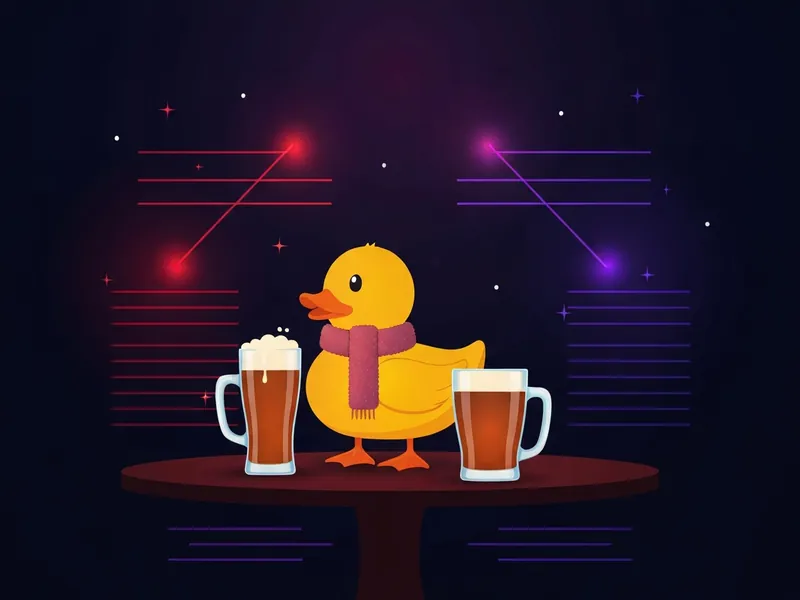
Fuzzy Duck is a tongue-twister with a trap built into its DNA. Players go around the circle saying 'fuzzy duck.' At any point, someone can say 'does he?' instead - which reverses the direction and flips the phrase to 'ducky fuzz.' Said slowly, it's nothing. Said fast, tipsy, after three reversals in a row, your mouth will eventually assemble those sounds in the wrong order - and produce a very rude spoonerism indeed.
That looming slip is the entire game, and everyone at the table knows it. The tension of watching a confident player rattle through 'fuzzy duck, fuzzy duck, ducky fuzz' at speed - waiting for the inevitable - is genuinely theatrical. Any mistake means a drink: wrong phrase, wrong direction, hesitation, or the slip itself, which traditionally costs double and about five minutes of the table crying with laughter.
The first player turns to their left and says 'fuzzy duck.' The next player does the same, and the phrase travels clockwise around the circle, player by player. Keep the rhythm brisk and even - the game only works at speed. A slow, careful Fuzzy Duck is just a group of adults saying nonsense at each other.
Instead of passing the phrase on, any player may respond with 'does he?' This immediately reverses the direction of play AND flips the phrase: the circle now passes 'ducky fuzz' counterclockwise. Another 'does he?' flips it back to 'fuzzy duck' clockwise. Reversals are the game's only weapon, and timing them cruelly is the entire strategy.
Each player must know both the current direction and the current phrase - and they change together, every time someone says 'does he?' Saying 'fuzzy duck' when the table is on 'ducky fuzz,' or speaking when it isn't your turn, are both fails. Most tables limit consecutive reversals (two 'does he?'s in a row maximum) to keep the game from stalling into a ping-pong match.
Here's the trap: alternate those two phrases quickly enough and your tongue will eventually swap the wrong consonants at the wrong moment, producing a spoonerism that is emphatically not suitable for grandma. Everyone knows it's coming. Nobody knows when. The slip is an automatic double drink and, by ancient tradition, the biggest laugh of the night.
A player drinks for: saying the wrong phrase, going in the wrong direction, hesitating past a beat or two, speaking out of turn, or collapsing into giggles before they even finish. The slip itself costs double. After any penalty, the drinker restarts the round in whichever direction they choose, at whatever speed their dignity can manage.
As the group warms up, push the pace. Some tables tap the rhythm on the table and require each phrase to land on the beat; others cut the hesitation window to a half-second. The faster the duck flies, the sooner someone's mouth betrays them - and speed is the difference between a mildly amusing game and a legendary one.
One player taps a steady beat on the table, and every phrase must land on it. Missing your beat counts the same as hesitating. The imposed rhythm removes the safety net of pausing to think, which reliably doubles the slip rate. Raise the tempo slightly each lap until the round detonates - it always does.
Reversals become limited ammunition: each player gets exactly two 'does he?' tokens for the whole game (use coins or bottle caps). Spend them wisely - a well-timed reversal after someone's been lulled by five straight 'fuzzy ducks' is devastating. When all tokens are gone, the game becomes a pure speed run to the finish.
Two phrases circulate at once: start a 'fuzzy duck' clockwise and, half a lap later, launch a second one. Players may end up handling both phrases within seconds, and reversals tangle the two streams gloriously. Strictly for groups of eight or more who have already mastered the standard game and want chaos.
Players must stare at the table - no eye contact, no visual cues about direction. You track the game entirely by ear. Removing the visual crutch causes constant direction errors even before anyone's tongue fails, and it makes the eventual slip somehow funnier because nobody sees it coming. Literally.
Elimination mode: fails knock you out of the circle (after your penalty sip) instead of restarting the round, and the circle shrinks. With fewer players, turns come around faster and the phrase alternates more per person, cranking up slip probability. The final two players duel at full speed until one mouth gives out.
Fuzzy Duck is widely believed to be a British pub game, and most accounts place it in UK drinking culture by at least the mid-20th century, though firm documentation is scarce - games built on a single risky spoonerism don't tend to leave paper trails. It likely spread through universities and the armed forces, and it remains a staple of British and Australian pub nights. The 'does he?' reversal appears in virtually every recorded version.
Published · Last updated · How we research games
Count around the circle - but 5s bizz, 7s buzz, and brains melt.

Build a story one word each - break the flow, take a drink.
Drum the table, throw your sign, catch theirs - miss and drink.

Spot the lie or drink - the classic icebreaker with a twist.
Wrong hand on your drink? BUFFALO. Finish it.
Two lines, one anchor, pure chugging - first crew home wins.
BestDrinkingGame.net is a drinking-games site made for adults. Please confirm you are of legal drinking age before you come in.
By entering you agree to our terms and to drink responsibly. Know the legal drinking age where you live (21+ in the US).
You need to be of legal drinking age to use this site. Thanks for stopping by, and stay safe.
Every game here can also be played alcohol-free once you're old enough. See you soon.