
World
Centurion
100 shots of beer in 100 minutes - the long war.
Race the course carrying a crate - it must be empty at the line.
Also known as: Beer Crate Race · Bierkastenlauf
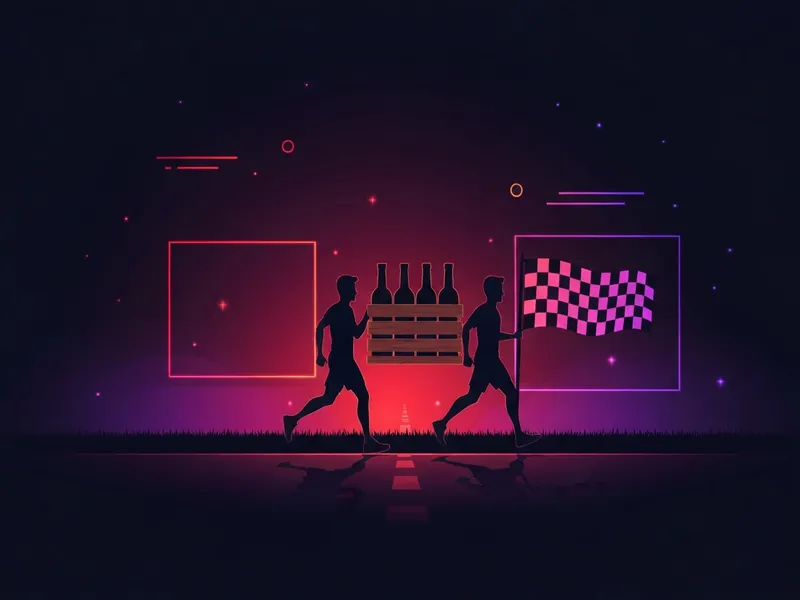
Kastenlauf - Literally 'crate run' - Is Germany's answer to the question nobody sensibly asked: what if a hike and a case of beer were the same event? Teams of two set off along a course carrying a full crate of beer between them. The rule is beautifully absolute: the crate must be empty when you cross the finish line. How you distribute the drinking along the way is your team's entire strategy.
Part endurance event, part logistics puzzle, part rolling picnic, Kastenlauf turns pacing into sport. Sprint early and the beer punishes you; drink too slowly and you're chugging at the finish while rivals stroll past. Real organized Kastenläufe happen across Germany, Austria, and Switzerland every summer, complete with registration, costumes, and marshals - And an informal version needs nothing but a crate, a partner, and a route.
Kastenlauf is a duo sport: you'll share the crate's weight and its contents. The ideal pairing balances a steady walker with a steady drinker - And ideally both. Agree roles before the start: who carries on which stretches, who opens bottles on the move, and what your drinking schedule looks like kilometer by kilometer.
At the gun, every team sets off carrying a completely full crate between them. It's heavy - A full 20-bottle crate runs about 20 kilograms - Which is the game's first lesson: every bottle you drink makes the crate lighter. Drinking isn't just the requirement; it's literally load management. The route ahead is your countdown clock.
Teams pause or slow-walk to open and drink bottles along the course, splitting them between partners however they choose. Smart teams drink small amounts steadily rather than stopping for chug sessions - A rhythm of one shared bottle per stretch keeps pace and stomachs intact. Empty bottles and caps go straight back into the crate; littering means disqualification everywhere this is played.
The middle of the course is where Kastenlauf is won and lost. Track your bottle count against distance remaining: if you're halfway with more than half the crate full, slow down and catch up on drinking; if the crate's nearly empty early, ease off and walk it in. The crate is a scoreboard you carry.
Approaching the finish, every bottle must be empty. Marshals (or the honor system) check the crate at the line - Full or partial bottles mean penalty time, a chug-it-here order, or disqualification depending on the event. The classic finishing scene is two partners standing 50 meters out, splitting the final stubborn bottle while faster-drinking rivals cruise past.
Both partners and the crate - Complete with all empties and caps - Must cross the line together. First team over with a verified empty crate wins. Organized events follow with food, live music, and awards for costumes as much as speed, which tells you what Kastenlauf is really about: the shared expedition, not the stopwatch.
A short-course version - One or two kilometers with a small crate or six-pack per team. The compressed distance turns careful pacing into open tactics: drink everything at the start and run light, or carry full weight and finish drinking at the line? Perfect for parks and parties where a 10 km course isn't happening.
The course includes marked stations where each team must show a minimum number of empties - Say, five bottles down by checkpoint one, ten by checkpoint two. This outlaws the save-it-all-for-the-end strategy and keeps teams honest about pacing. Standard at organized events, and easy to improvise with chalk marks and a volunteer.
Teams of four split the course into legs, handing the crate off relay-style, with each pair responsible for their share of the bottles. Halves the drinking per person while keeping the full race distance - The responsible scaling for bigger crates or longer courses, and a great format for club events with mixed fitness levels.
Many real events score costumes alongside race time - Lederhosen, superhero duos, two-person horse outfits wrestling a beer crate along a trail. Award separate prizes for fastest team and best-dressed team so slower crews still compete for something. In practice this is the variant everyone remembers photos of.
Swap the crate's contents for radler (beer-lemonade shandy), low-alcohol, or alcohol-free beer - Same weight, same rules, a fraction of the alcohol. Ideal for longer courses, hot days, or mixed groups, and common as an official category at organized races. The crate doesn't care what's in the bottles; the race is just as real.
Kastenlauf (Bierkastenlauf, 'beer crate run') comes from the German-speaking world, where beer is sold in sturdy 20-bottle crates practically designed for two handles and two carriers. Organized races appear to have grown out of student, village-fest, and sports-club culture - Many local events date to the 1990s and 2000s, and Switzerland and Austria host well-known annual runs. Origins beyond that are hazy, but the format is now a beloved summer tradition across the region.
Published · Last updated · How we research games
100 shots of beer in 100 minutes - the long war.

Germany's park classic - hit the target, chug while they fetch.
One stump, one nail each, one hammer - last nail standing drinks.
Nine pubs, nine pars - the great British drinking crawl.
Four laps, four beers - the people's endurance event.
Teams, events, medals - the full games, with beer.
BestDrinkingGame.net is a drinking-games site made for adults. Please confirm you are of legal drinking age before you come in.
By entering you agree to our terms and to drink responsibly. Know the legal drinking age where you live (21+ in the US).
You need to be of legal drinking age to use this site. Thanks for stopping by, and stay safe.
Every game here can also be played alcohol-free once you're old enough. See you soon.